March is almost over after fickle weather of snow, rain and one day–a balmy 72. Time to post before March ends.
Every March since 1982, ten women’s organizations across Bucks County select ” … a woman who best exemplifies the social, intellectual and creative contributions women have made to our future …”.
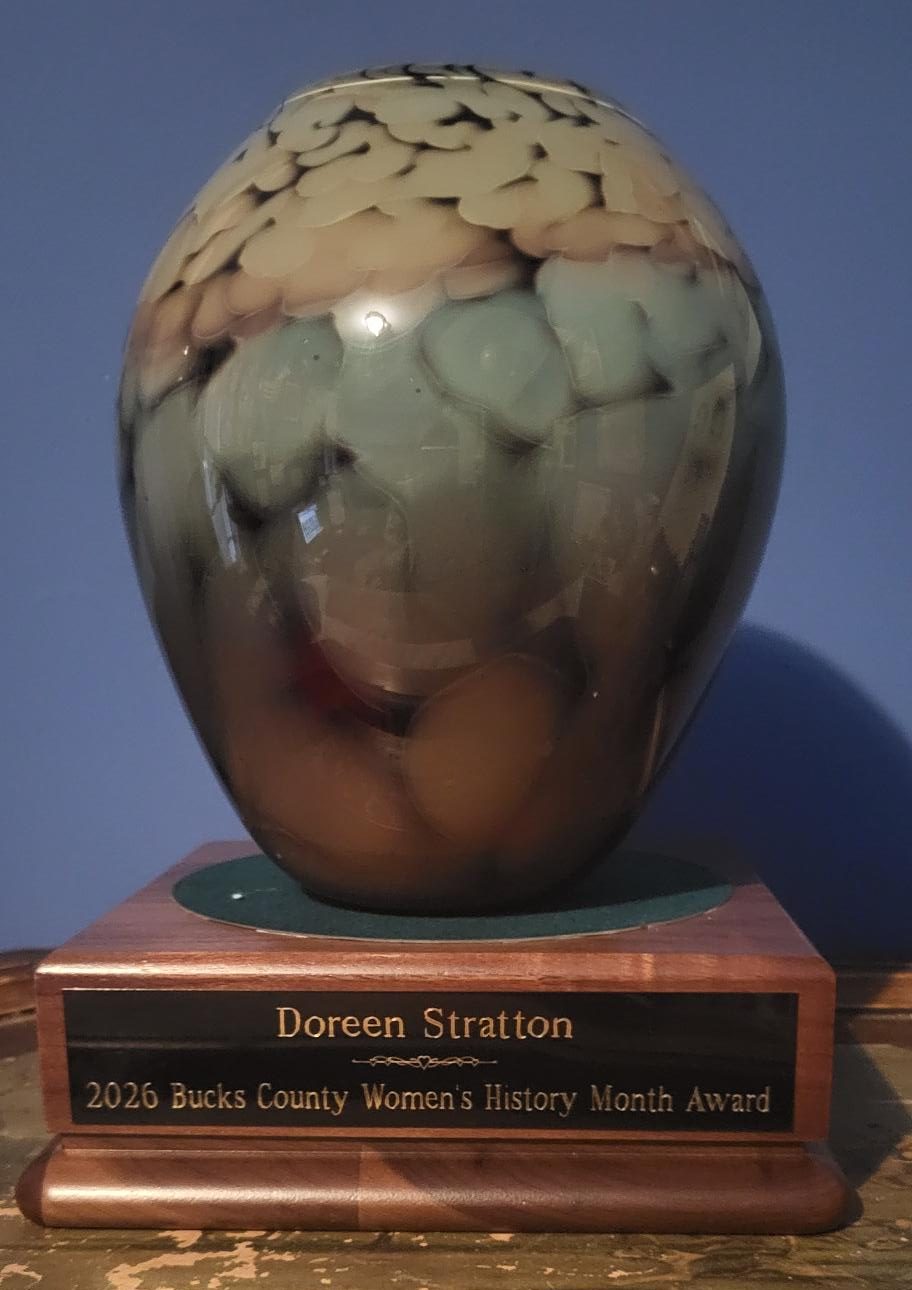
The Bucks County League of Women Voters is one of the ten. This year, the League–through Jean Weston, a member of the League, had nominated me to become the recipient for 2026. It was my honor to share my remarks from the Thursday, March 19, 2026 ceremony at the James Lorah House in Doylestown.
******
Thank YOU, Maggie Wallace-Cullen for that introduction.
Maggie is my daughter from another mother.
Thank you, League of Women Voters of Bucks County for the nomination, and Jean Weston of the League for nominating me.
Kathleen Horwatt? Ashe oleng (it means thank you very much in Maasai). Kathleen oversees this annual event which raises women high in the sky.
My appreciation to Tara Tamburellao, for the poem in my honor. Yes, l am honored to receive the 2026 Bucks County Women’s History Month Award.
First, I’d like to introduce my family. I’m one of six siblings.
My oldest sister, Barbara, was unable to travel from Delaware. As was my brother Chris. Barbara and Chris are Central Bucks High School Hall of Fame recipients. My oldest brother Jim passed away in 2017.
My brother John is here. John is also a recipient of the central bucks high school hall of fame. In 2008 he was honored for baseball. There were multiple Doylestown boys who had learned from John the art, skill, and joy of baseball. Read more about my brother on my blog, the Bucks Underground Railroad, of June 17, 2020: “Black Dreams Matter”.
My sister Judith is here—Introspective, Judith surprised all of us by moving to New York City. One day she took a bus ride to Central Park and discovered a love of horseback riding. It takes a strong-willed woman to saddle and control a 1500 plus pound animal.
She like me, returned to Doylestown. Judith is a member of the via and a docent for the James Lorah House. She is a Penn State Master Gardener and the Coordinator for the Doylestown community garden.
My two California born children—Mark Jackson and Mélanie Spelts.
Melanie is an equestrian trained by Judith. Then, she trained her two daughters—Aleeya and Gracyn. Now my great-grandaughter Audrina–at age 6–has begun winning equestrian ribbons. Work schedules kept them from attending tonight.
Finally, I must give Mélanie a proud shout out for beginning her fifth year in recovery.
Mark could not be here. Mark shares videos of rebuilding classic cars from their frames. His wife Christine is a Souderton high school physics teacher. Often, they fly to California for visits to Mark’s uncle, Reggie Jackson.
My remarks tonight . . . Are there any women?
After I came home in 1975, I think those ten years in California had prepared me for this long journey in activism. Three years later—1978—I carried an anti-nuke sign, protesting the three-mile island nuclear power plant accident. Our feisty group was called the Central Bucks Clean Energy Collective. And our slogan? No Delaware Water to Limerick.
It was also a time I began writing and volunteering on political campaigns. In 1983 I was offered a position in the Doylestown District Office of Congressman Peter H. Kostmayer. Just a year earlier, you may remember the National Vietnam War Memorial was dedicated in Washington, DC. That event inspired veterans across America to construct memorials and monuments within their communities. BUCKS COUNTY WAS ONE OF THEM.
Near the end of 1983, our congressional office was asked to assist the County Memorial Committee. Our task was to verify Bucks County names that had been killed or missing in action in the Vietnam War.
My assignment was to research local newspaper archives, contact veteran groups and families of deceased service members. I savored this assignment. My 2nd husband was a Vietnam War combat veteran.
When I received a name killed or missing in action, I called the archives in Washington, DC. They would check the master list of names on the wall and if there was a match, we had a name to etch on our wall. This project made me curious. . . . Were women casualties etched on the wall? During one of my calls to the archives, I asked, “are there any women on the wall?”
“Yes”, he answered, “There are eight of them. Would you like the list? I’ll send it to you.”
Who were the eight names? How come I’d never heard of them? I had followed the war and now I wondered . . . How could military service women die in the Vietnam war? Where was the coverage?
True, it was an unpopular war. Casualties coming home in coffins. However, I was aware women served in the military. Some resided on the family compound where i lived with my first husband near Travis Air Force Base.
Years later, I would learn that during the Vietnam War, possibly 10,000 women—nurses, air traffic controllers, communication specialists, and civilians had served in-country.
When ‘The Wall’ was dedicated, many veterans had reacted negatively: “It’s just a gash in the ground!”. Eventually it would be embraced by the men and women that traveled there. My first time at the Wall, I stood on the rise. The granite “V” is nestled in Mother Earth. Maya Lin’s minimalist design is beautifully powerful. To me, the wall is a female nurturing the souls of all who visit, and all who died.
I witnessed veterans standing on the rise. For lengths of time, they stared at the wall. In silence. Weeping. Some hesitated. . . . Not yet ready. Others walked across the grass down to the Wall. And hands, fingers . . . Touched the names.
In 1993 a memorial was dedicated to women of the Vietnam war. Sculpted by Glenda Goodacre, the monument, on an area above the wall, encircles three women and a wounded soldier. They scream at the heavens as they heal and protect the rescued warriors.
So, you ask, who are the names
When the names of the eight women arrived, it was on one sheet of paper. All were officers and nurses. Seven had served with the Army Nurse Corps. The eighth woman, with the Air Force Nurse Corps. The list also included two male Army Nurse Corps officers.
The causes? Eight deaths included two male nurses caused by aircraft accidents. The other two deaths?—one died from a rocket that hit her hospital—and the other from a subarachnoid hemorrhage.
Seven of the women were my age—give or take two years. The eighth nurse had served in World War II, Korea, and Vietnam.
I dove into research. Newspaper clippings from their hometowns brought these women to life. I asked myself: what should I do with this information? By then I was an accomplished closet writer. Stuck in a cabinet were my journals, a one-act play, three short stories, several essays, and a work-in-progress novel.
If I wanted to write about any of these women, i must first gain approval from their families.
I called and introduced myself and said, “I want to write about your daughter.”
Early in this project, I had met my first two women veterans—both had served in Vietnam. We became friends: Grace Moore–a combat nurse. Denise Black—a unit supply clerk
In 1986, my research led to an article placed in The American Journal of Nursing. It was the first time all ten Vietnam military nurses had appeared in a single publication.
Researching, interviewing and writing while employed was my challenge. A project of this depth required the resources of time and money. After the AJN article, the National Vietnam Veterans of America placed a notice in their national newspaper. Soon, I began receiving responses from combat nurses and infantrymen. Sometimes I succeeded in interviews; other times nurses were not ready to revisit that passage of their lives.
However, those instances when combat nurses gathered at veteran events or ceremonies, I witnessed a sisterhood of women. They acknowledged there were shared experiences which we could never comprehend. They had returned home, with lost innocence; aged beyond their twenty-something years.
My project about women veterans lasted a decade. Letters, phone calls, interviews and travels to their homes resulted in three drafts of mini biographies. I traveled to Scranton Pennsylvania, to New Jersey, to north and South Carolina, to Massachusetts and several visits to the Vietnam wall in Washington.
I failed to travel into Ohio, Indiana, and Michigan, the homes of the other nurses.
Each of the three drafts are under 200 pages.
–2nd Lt. Carol Ann Drazba, Pennsylvania
–2nd Lt. Elizabeth Ann Jones, South Carolina
–2nd lt. Pamela Dorothy Donovan, Massachusetts
If any are interested, I’ve brought reprints of the AJN article.
In 1989, I was asked to edit the Pennsylvania VVA Newspaper. For the next three years I interviewed, photographed, edited, and laid out the monthly newspaper which was sent to veterans and supporters across the Commonwealth. As the paper’s editor, I had an assignment to attend the Pennsylvania VVA when they met once-a-year inside a state maximum security prison. The National VVA Charter supported veterans who were incarcerated. They realized many veterans’ tours led to unlawful activities.
That introduced me to prison advocacy and ended my VVA activism. In 1994 I founded The School of Hard Knocks, Inc, a non-profit youth- at- risk intervention corporation.
Other evolutions of my activism continued.
It was 1999 when I discovered the depths of my African heritage. I had traveled to Ghana and a year later, Egypt. My journey continued when, in 2005, I met two amazing women. Two are here this evening. Phyllis Eckelmeyer, one of the two co-founders of the Maasai Cultural Exchange Project, Inc is here with Alice Sparks. We traveled to Kenya in 2015. Over several years, community donations from Bucks County citizens funded seven water wells. Now, potable water is available for a Maasai village of 5,000 people.
Another mission of MCEP was women. The NGO we collaborated with encouraged empowerment for their women. The organization also promoted education for Maasai children. Over 100 Maasai students were able to attend school because people wanted to sponsor a child. Some of the students have attained college degrees and have taken their knowledge back to the village.
In 2015, on my second sojourn to Kenya, I met 5-year-old Lisa. I decided to sponsor her education. Every year, my donation of $150.00 has carried Lisa into every grade. She has now matriculated into grade 10 at a boarding school in Nairobi. I dream of returning to Kenya and witness Lisa’s graduation.
This day in Doylestown, we celebrate Bucks County Women’s History Month. My remarks about military women likely initiated my years of activism. I want to honor three military women who—in the first three weeks of war in Iran, made the ultimate sacrifice.
Capt. Ariana Savino, 31, Covington, Washington; Sgt First Class Nicole M. Amor, 39, White Bear Lake, Minnesota; and Tech Sgt. Ashley B. Pruitt, 34, Bardstown, Kentucky
The Commander-in-Chief has labeled Iran “. . . An excursion. . .”. At the end of the 20th Century, there were women in uniform that had been promoted to leadership roles as Generals or Admirals. The current administration has purged them from the Pentagon. Black Women. White Women.
The Heritage Foundation has released an addition to Project 2026: The Golden Age. A blueprint to suppress women by taking away our right to vote.
I speak these words because I fear for our Democracy–
The world burns
as Nero
Fiddles and prances
on
the demolished East Wing
of The People’s House
–-Doreen Stratton, 3/19 26 at
Bucks County Women’s History Awards Ceremony
When Alice Paul was 32, she and other women were dragged to jail for holding a sign asking to Vote. It was 1916. While in prison, she and the women went on a hunger strike. They were released a year later. On August 19, 1920, the 19th amendment ratified women the right to vote.
Among our family archives, I found a piece of paper, ink faded from age, yet the name on it was still visible. It was my Grandmother: Lillie B. Stratton. Once a teacher, she was widowed in 1900 after her husband—my Grandfather, a veteran of the Civil War—had died. At the age of 49 with 10 children, in 1939 Lily had registered to vote.
Our family’s old polling place was the Doylestown Borough School. There’s now a parking garage where it once stood. Once upon a time growing up in Doylestown, on every election day, I would take hold of my mom’s hand and we and Daddy walked those three blocks to the polling place.
Those were the days of the old lever voting machine. You had to flip the levers for the candidate. As I stood in the booth with my mom, straining my neck upwards, she picked me up and tucked me close. With her free arm, she guided my hand to hold the big lever as she pulled.
The curtain opened, her vote was counted
DO SOMETHING SPECIAL:
Take your daughter or son to the polls On Tuesday May 19.
-END-
 The Bucks Underground Railroad
Congratulations on receiving your well deserved recognition of all the work you gave done educating people!
Sent from the all new AOL app for iOS
LikeLike