Calling All Ancestors

A few weeks ago, a colleague, said, “You know, after someone dies, that person will remain alive as long as there is someone to say their name.”

February is Black History Month. It is the month when African Americans celebrate their ancestors’ legacy. On Tuesday February 3, beginning at 7:00 pm, I will call out my ancestor, my Grandfather, Joseph B. Stratton, who served with the Union Navy from 1863-1864 in the Civil War.

Through the wonders of Zoom, I am honored to sit inside the Bucks County Civil War Museum and Library of Doylestown to present a Power Point lecture about my Grandfather. From the comfort of your home, you will learn about one Black man’s experience that happened during a significant chapter in our Nation’s 250 years of Democracy.

Please register for this free event at this email: civilwarmuseumdoylestown@gmail.com. Join family, friends, and history buffs while I share my Grandfather’s legacy who during the Civil War, served on a blockade runner along the Eastern shore from Wilmington, Delaware to South Carolina. Equally, it is exciting for me because I will present this Zoom from the Doylestown Civil War Museum and Library, where I will be surrounded by their collection of artifacts and documents.

The picture with this narrative is the only image of my Grandfather. However, through the wonders of Ancestry.com, we have traced our Stratton surname to Tobias Stratton, my Great-Great Grandfather, born a Free Black in 1767 Philadelphia.

Tobias married Harriet Mintas in 1795, a Jamaican woman. Our Stratton legacy had begun. We know little about my Great-Great Grandfather’s life in Philadelphia. I imagine him walking the cobblestones of the city. Did he see Benjamin Franklin at his printing press? And at age 9, did he push his way through a joyful crowd for a better position to witness the reading of the Declaration of Independence for the first time?
Who, I wonder, were my ancestors before Tobias?

The first Africans arrived on the shores of Virginia in 1619. For two hundred years, enslavement created a gap of procreated amnesia. My DNA chart from Ancestry.com discovered 45% of four different north European countries and the rest? Ten different countries from Africa, my Motherland.
Gaps.

Currently there is an intolerant crusade, determined to erase Black existence, it is rumbling across America, determined to forbid the culture, contributions, and history of ancestors such as mine: Joseph B. Stratton—a Black man of America: a son, a husband, and a father; he was an educated man, a barber, an activist, a veteran of the Union Navy, and a patriot. He was my Grandfather.
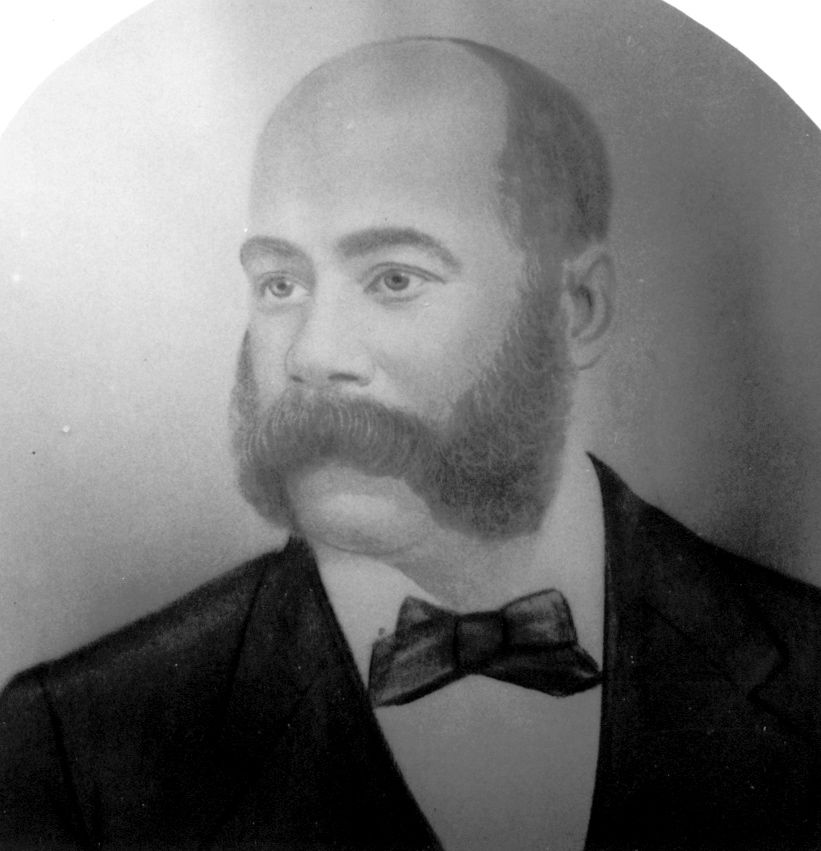
Joseph B. Stratton

Science — 1793

Someone once told me, a book often languishes on our shelves, patiently waiting for the time when we will finally read it. In 1984 I had spotted “The Book of Philadelphia” by Robert Shackleton at a book fair, piled among many others on a table with a poster stuck at the top that announced: FREE BOOKS! My eye had caught the title because some of my ancestors had settled in Philadelphia. I grabbed the book, carried it home and there it rested until about a month ago when I pulled it off the shelf.

Published in 1918, the pages of “The Book of Philadelphia” radiate a musty odor wafting up from heavy fibered paper, indicative of books published a hundred years ago. The edges of each page are lined with a brownish tinge while some pages throughout the book, display sketches, either of streets, buildings or people—each image protected by a leaf of delicate tissue, yellowed with age.

I skimmed through the book and paused when discovering a few sentences about the 1793 Yellow Fever epidemic in Philadelphia.

What a coincidence! Bucks County is in the midst of a Covid epidemic. In addition to the hospitalized and the dead, people are refusing the vaccination and/or wearing masks. There have been protests against closures and lots of unhinged individuals behaving badly in public spaces. Compared to this 21st Century pandemic chaos, how I wondered, did the People of Philadelphia survive the 1793 pandemic? Mr. Shackleton devoted two pages where he briefly mentioned Dr. Benjamin Rush; the plague and treatment, just enough to whet my curiosity.

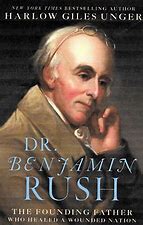
That year of 1793 the population in Philadelphia was around 50,000. Shackleton describes a city already established with narrow streets and brick row houses. In August 1793 the first death was reported. Soon thereafter people were dying in the streets. Dr. Benjamin Rush, one of the original signers of the Declaration of Independence, became the leader in fighting the plague, soon identified as Yellow Fever. The doctor believed “putrid exhalations” in the air caused the disease; and he ordered cleaning the unsanitary conditions at the docks, rotting food, and the sewage system.

Dr. Rush organized crews to roam the city, pick up the dead and carry them to burial sites. Philadelphia was the Nation’s Capital. Soon nearly 20,000 people fled this hot and humid summer including Thomas Jefferson, George Washington and much of the federal government taking refuge in Germantown. Some citizens blamed the plague on blacks arriving in Philadelphia after fleeing the revolution in the French Caribbean colony (now Haiti).

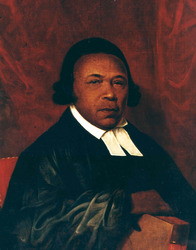
The doctor believed the blacks were immune to the disease and pleaded for help from black community leader Absalom Jones, an abolitionist and clergyman who founded the first African Methodist Episcopal Church. The African Americans became instrumental in all tasks from nursing, cart drivers, coffin makers and grave diggers. When the plague began infecting the black community with sickness, 240 African Americans died. The estimate by modern scholars is that close to 5,000 people died during the plague. It spared no one.

Absalom Jones

There was no cure or vaccine for Yellow Fever. Samuel A. Gum’s article described how Dr. Rush kept meticulous notes and developed a treatment of “…blood leaching and purging …a mercury compound as a method to purge the bowels.” When the doctor fell ill with Yellow Fever, he instructed one of his assistants administer the treatment to him. He survived as well as many other hundreds of others who received his treatment.

I close with this: Considering that 200 years ago, the various ingredients Dr. Rush must have experimented with, it was Science that saved those lives.

NOTE:

(An undated article published in the Pennsylvania Center For The Book, titled “Philadelphia Under Siege: The Yellow Fever of 1793” by Samuel A. Gum Philadelphia was my source for much of this post.)

The portrait of Dr. Benjamin Rush can be viewed in the National Gallery of Art in Washington, DC. This is the cover of a biography written by Harlow Giles Unger, September 11, 2018. Dr. Rush was also the Founder of Dickinson College, where a statue has been placed.