Scraping Doylestown History

(Photos by Doreen Stratton)

There are times when life treats you with a piece of knowledge about your hometown and you tuck it away, unless it pops up in your memory bank at an unexpected moment. Eleven years had passed before it happened for me.

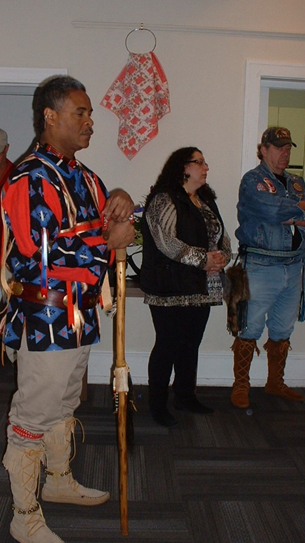
It was Saturday, April 6, 2013, when a Historical Marker was unveiled at the corners of State and Main Streets in Doylestown Borough. The marker dedicated this intersection as the trail for the Lenni Lenape (Le-NAH-pee) Nation as they traveled from the east and from the south to their destination, the Delaware River.

The Doylestown Historical Society with assistance from Melissa Cornick, a journalist, and strategic communication specialist (for professional activities), coordinated the day’s event which included a lecture by Professor Evan Pritchard, descendant of the Micmac people (part of the Algonquin Nation).

Earlier that same day Professor Pritchard, an Algonquin Historian, had lectured to a packed audience at the Doylestown Presbyterian Church. I was impressed with Pritchard describing the Lenape historic trade route, the stop at State and Main Streets, their ancient land use, and the pathways along what became Routes 202 and 611. At the conclusion of the well-gathered dedication at the Marker, there was a lively afternoon Pow Wow at the Doylestown Historical Society Park.

Pritchard’s visit to Doylestown also had allowed him to tour some of the tunnels which remain below our town’s streets. Thousands of years ago these “tunnels” were caves where the Lenape, a nomadic indigenous tribe, rested after traveling from the shores of the New Jersey Atlantic Ocean. (I like to believe those tunnels, thousands of years later, were safe places for fugitive slaves in the 1800s)
Eleven years after the Lenape Marker had its dedication, the front-page April 4, 2024, edition of the Bucks County Herald reported:

“Bucks County Historical Society’s Doylestown Twp. Land eyed for luxury homes.

“Custom home builder Richard Zaveta outlined his concept for an upscale community on 24 acres owned by the Bucks County Historical Society in Doylestown Township at the supervisors’ meeting Tuesday.”

https://buckscountyherald.com/stories/bucks-county-historical-societys-doylestown-twp-land-eyed-for-luxury-zaveta-custom-homes-fonthill-mercer-museum,43733

Where, you ask, is this land?

When you drive south on Main Street in Doylestown Borough, across from the new WAWA is a thicket of trees—24 acres—fanning from Main Street, bordering the bypass until the trees bump against a large development of single-family homes. This land is in the Borough’s neighbor, Doylestown Township. Years ago, this acreage was three or four times beyond that number when the land was either woodland or farms.
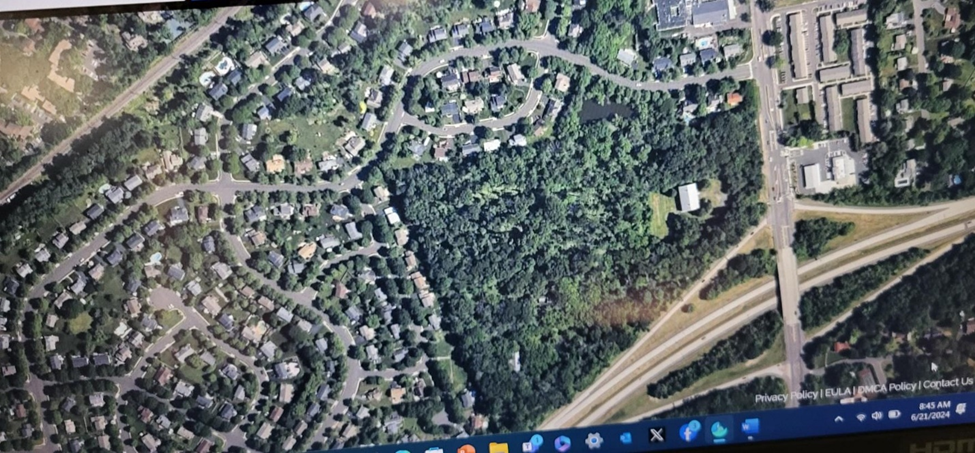
(24 acres from the google map)

SOME HISTORY

Hidden in that forest once was a popular venue called The Hustle Inn, where teens gathered and danced to live bands. In the early 1940s, Ellis and Anita Smith purchased an 1848 farmhouse and barn, and converted the second floor of the barn into what would become The Hustle Inn. It operated from 1946 until 1966. I had relocated to California for ten years so missed the 1964 drama when outsiders came into town, resulting in a fight involving three hundred people.

https://patch.com/pennsylvania/doylestown/this-was-doylestown-1964

The Smiths sold their property in 1967. Eventually it was purchased by the Matthews School of Fort Washington. They renovated the barn as a dormitory for young boys.

The January 12, 1970, The Morning Call, published an article about the end of an era when a fire destroyed the building formerly called The Hustle Inn. No one was inside the structure at the time of the fire. A cultural piece of Doylestown History was ashes but is still cherished in a private Facebook page.

Image of The Hustle Inn — Courtesy of Spruance Library, Mercer Museum

Then, early in 1991 the acreage was carved away for 99 single family homes. I often wonder, could the Lenape have paused there to rest, eat, and drink? (there was water in those woods). This area was rich with springs, many now gone due to extensive land loss. And where the Lenape Crossing Marker is placed, there was a natural spring from which this indigenous tribe drew water, and how “The Fountain House” received its name.

On April 18 The Herald published an opinion from Doylestown resident Mary Hughes expressing her concerns about this proposed development. She mentions “ . . . the vast number of historic objects and equipment . . . which many people outside of the organization may be unaware.”

https://buckscountyherald.com/stories/historical-societys-proposed-land-sale-at-odds-with-its-mission,45618

This past May I walked onto the woods through an access road. I’m not embarrassed to admit I’m a tree hugger. Standing on the access trail, I was at a loss for words gazing up at the canopy of green. We’re losing precious land. I strongly encourage the Township and the Historical Society to consider an archeological study and an environmental impact study before any bulldozer knocks down any tree.

It’s Father’s Day Weekend . . .

. . . and posts have already begun to appear on Facebook, people sharing memories along with a special photograph of either their “Dad”, or their “Pops”, or their “Pa”,  or their “Father”, or their “Daddy”. I and my three brothers and two sisters stuck with “Daddy”.

For one hundred and twenty-three years, we have lived in the same Doylestown house where my father was born in May 1900; and where he chose to spend the last few weeks of his life when he passed on April 7, 1993. Weeks later at his memorial service, here are the words I spoke:

When a person leaves this Earth, their last piece of legacy is defined on a line printed on the death certificate. So it seemed appropriate that my brother Chris chose to have written on Daddy’s certificate 

“A MUSICIAN AND A GARDENER”

Grayson Savoy (Sid) Stratton

Throughout my father’s life he was many things to many people. He was a printer, an elevator operator, a factory worker, a film extra, a writer, a custodian, a Chauffer, a Civic Activist, a tennis player and an orchestra leader.

After he retired, he spent many hours tending to his home, mostly the grounds and gardens he loved so much. His flowers were the envy of the neighborhood. His vegetable garden burst with edibles, and he would boast, “Me and God made this”.

For awhile after retirement, he continued playing music at weddings and special affairs. One memory I still hold is how, every Saturday afternoon, late in the day, he would practice scales on his saxophone. If it was a warm day like today and if you were outside sitting on the grass or patio, you would be able to hear the mellow sighs of his saxophone floating down from his second-floor window.

For several weeks before his death, he was confined to his bed in his room. During the last week of his life, while sitting with him one day, I looked around his room and covering the walls was the saga of our family. A History of his life. Looking at the old marriage license of his parents, photographs of my Grandmother and Grandfather; and my Father’s Brothers; and pictures of our home covered in snow and another flooded with summer light.

Then also there were the hospice nurses who came to care for Daddy—they are truly Angels on Earth. He would tell them stories from those framed mementos, stories about the Life of my Family.

Almost two months ago, Daddy asked that we get all the Family together. My brothers and sisters did have the chance to see Daddy and say their Good-byes. Four days before Easter Sunday, Daddy left us to meet his Creator.

He made his Peace.

Because a Family is also a Community, I know that he knows all of us are here at this memorial to say our Good-Byes. He would like that.

Daddy planted his gardens with the music of Life. Although my brothers and sisters are as different as flowers in a Spring garden, and the tunes we sing are in different keys, we have in us a Sense of Family. The pictures on the bedroom walls give us the music of hope that we can sing to our children and grandchildren. Their roots are deep in the soil at our Ashland Street house.

My father was a musician and a gardener.

Daddy, may you spend this Father’s Day in Heaven with your brothers, sisters, and ‘JB’ and Lily.

SANKOFA

News of police stops of African Americans in their cars brought memories of incidents my father had experienced during the mid-1930s through the early 1960s. His band played a lot of gigs in Philadelphia. Every Saturday around 5 o’clock he would gather his sheet music and the case holding his saxophone, and drive into Philadelphia where they performed at different clubs. Coming home to Doylestown, at 3 or 4 in the morning, he would be pulled over on 611 just south of home. Always by the same cop.

And always with the same interrogation: The cop asked for his driver’s license and registration. Then he’d ask where was he coming from and where was he going. He responded politely with the same answers. After I and my five brothers and sisters reached our teens, my father would caution us about behaving properly out in public: “Be respectful and never draw attention to yourself”. We failed to understand why he told us to “behave”. We always behaved.

Years later when an adult, Daddy had shared with me the police interrogations. I tried to imagine what else, as a Black man driving those country roads and city streets at night had he been subjected to? No wonder he gave us “the talk”; he was probably terrified that something like that would happen to us.

We were raised in Doylestown which in the mid1950s was a sleepy community of just over 5,000 people. It was a time when my family was called “colored”. The term “Black” was still years away, as was the ethnic term “African American”. There were only eight “colored” families in the Borough. We jokingly described ourselves as Raisins in a Sea of Rice.

As siblings of color when we stepped out the door, we walked into a milieu where our lives interacted with a majority of white friends.

I’ve often wondered how my family’s life would have been different if we had grown up in either Mississippi, Georgia, Alabama, Arkansas or Virginia or elsewhere. But we grew up in Doylestown, Pennsylvania where only on rare occasions the ugliness of racism reared its head. There’s only one time I can remember being called a “N****r”. As a 10-year old tomboy I picked a fight with a boy after he called me the “N Word”. I won the battle of our fisticuffs under the merry-go-round, surrounded by shouts of kids taking sides for me or him. I was banned from the playground for a week.

Since George Floyd’s murder the loudest voice for change is recognizing education’s failure to include 400 years of African American history and culture in our public schools.

The illustrations on my 1st Grade reading primer featured Dick and Jane, Spot the dog, Mother and Father, the mailman, the police officer and the fireman. I never gave much thought that this 1949 primer showed white faces on every page. Now the current introductory readers have progressed to reflect the faces of America’s diversity.

In my 5th Grade McGraw-Hill Geography text, the awareness of my skin color was reflected back at me from a page devoted to the African continent. The hand-drawn illustration remains embedded in my mind: An African child crouched in a hole with arms hugging his knees. Only the crown of his head is exposed. The African plain of tall grass in the distance is on fire and rages toward the boy in the hole.

The brief narrative accompanying the image explained that as the fire burned through the grass and reached the dugout protecting the boy, it singed his hair. The caption explained how Africans’ hair became “curly” as a result of the fire that raged across the African plain. My two sisters—one older and the other a year behind me, also remember that image.

During 1965 through 1975 I lived in California. Even at that time there was a diverse racial population. Often, I was asked, “What are you? Mexican? Philippine? Hawaiian? Native American? Who are you?”

This was the period of the Anti-War protests, Black Power and the Civil Rights Movement.

Not until 1999 after a journey to Ghana, a country on the West Coast of Africa, did I discover “Who” I was. When my feet touched this African country for the first time, the air embraced me with an aroma heavy with the psychic energies of Black and Brown civilizations. Three more times I would travel to Africa and each time the Motherland welcomed me with its pungent odor.

The frightened African boy hiding in a hole? Gone and replaced with my anxiety as I stepped carefully along a stone passage into the underbelly of a massive fortress built in 1653 by Swedish traders. Cape Coast Castle logged timber and mined gold before the lucrative trade of Africans, already a success in other fortresses constructed during the late 1500s.

Captured Africans were kept in a dungeon with stone walls that rose nearly 30 feet, with sunlight slipping in through one small window near the ceiling. The floor measured approximately half a basketball court. Standing near a wall, I listened as the guide described how hundreds of male Africans were crowded into this space before herded through a passageway onto the beach, then loaded on to a ship, bound for the New World.

I moved closer to the wall and ran the palm of my hand across the smooth blocks, wondering if the African DNA in me could’ve struggled for survival while cramped in this suffocating prison. I inched my fingers between two blocks and scraped granules of detritus into my hand, wrapped them in a tissue and brought them to America. They are more than what my ancestors carried when stolen from the Motherland.

It’s been 400 years since slave traders hauled human beings out of Africa. We survived the captors, the Middle Passage, bondage and the struggle for Freedom. Now is the time to sit across from one another and solve our differences.

There is a Ghanaian word spoken in the Twi dialect: Sankofa. It means “Go Back and Get It. The hen reaches back for the egg symbolizing that before knowing Who you are, you must first learn Where you came from.

Black Lives Matter

“… Great Again” Really?

Since the infamous “shithole” statement uttered by the President of our United States, the print and cable commentators have reminded us that Trump’s 26% hard core voters are probably applauding yet another racist utterance from his mouth.

I live in Doylestown Borough where during the 2016 campaign season there were LOTS of Trump signs planted on the front lawns of homes. Pennsylvania went for him but the Borough went for Clinton. I wonder how many of those Trump voters in my community still support him, even as he continues to lack dignity or sanity. And I wonder how many Doylestown hard core Trump groupies hate Americans who are Black, Brown, Red or Yellow? Like me.

Six years ago a letter to the editor by a local woman was published in the “Intelligencer”. Christmas, the day of Good Will was a couple weeks away when she wrote:  “Santa Claus used to be a big fat man with a long white beard. Now, he is a skinny black man in a big white house.”

The paper published my rebuttal. As a ‘skinny black woman’, I invited her to engage in a dialogue about race. When a friend offered to facilitate the meeting, the woman declined. Instead she suggested I “go back to Africa.” Chalk up at least One Racist in my community.

Having traveled to the African countries of Egypt, Ghana, and Kenya, it is complicated when the president brands those nations and others as “shithole”.

Five hundred years ago European nations landed their ships on West African shores. They plundered Africa’s natural resources—humans included—shipping them back to countries in Europe, South America, America, or the Caribbean.

The mid-20th Century brought independence to African nations across the continent. After years of observing how their conquerors’ ruled, some African leaders chose to emulate their predecessors when ruling their freed people.

A few African rulers attempted to bring True Democracy. Last year I learned my African DNA traces to Ghana. When I traveled there in 1999, it captured my soul as soon as I planted my feet on its soil. That country–similar to all African countries–holds rich cultural histories that reach back thousands of years.

In 1957 Ghana was the first country liberated on the continent from the colonialists. Its first Ghanaian Prime Minister was Kwame Nkumah, educated in America. In its capital of Accra, there is a monument erected in honor of Kwame Nkumah.

While China crawls throughout the African continent grabbing its treasured minerals, America is led by a fool who continues to lie and who dismisses the second largest Continent on Planet Earth. Chinese funds constructed that monument to the first African Prime Minister who adopted American Democracy. During my 2015 sojourn to Kenya I traveled across roads built by China. China also funded the construction of the rail line from Nairobi to Mombasa.

For this American president demanding Africans stay “… in their huts” proves again his ignorance to America’s reputation around the World and his complete absence of empathy.

The Rev. Martin Luther King, Jr. and all the Freedom Marchers are weeping down on us from Heaven.

Washington DC Monument to Rev Martin Luther King, Jr.